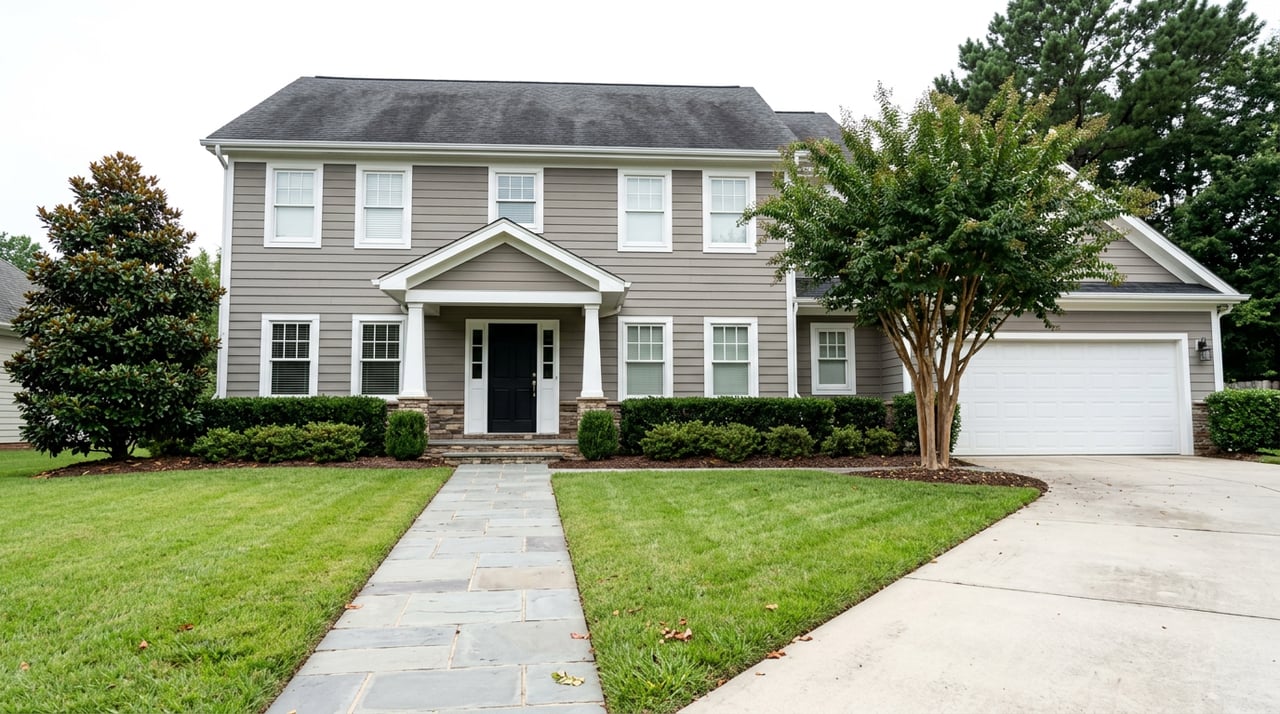
"What this does is it shows what the value of the Fort Mill School district is. It's worth $30,000 on a house."
That's York County Councilman Andy Litten, explaining his vote in April 2025 to raise the Fort Mill School District's construction impact fee to $29,640 per single-family home. He meant it as a compliment to the district. For anyone comparing new construction across the Lancaster County line in Indian Land, it's also the clearest explanation you'll get for why two homes that look similar on paper can start from very different numbers before a single stud goes up.
Most comparisons between Indian Land and Fort Mill start and stop with the resale market, where median prices on both sides of the county line have moved close enough together that neither side reads as the obvious value play anymore. What that comparison misses is a fee that has nothing to do with resale homes at all, and everything to do with what it costs a builder to pull a permit on a new one.
The Fee Only New Construction Pays
South Carolina counties can charge a one-time development impact fee at the moment a building permit is issued, and both York and Lancaster counties use this tool to help their school districts pay for growth without going back to voters for a bond every time enrollment climbs. The fee is charged to the builder, not the buyer directly, but it gets folded into the price of the home before it ever reaches a listing sheet. A resale home that changed hands last year never had this fee attached to it at the point of sale. A new-construction home permitted after the fee took effect did, and the builder priced accordingly.
That distinction is the whole story here, because Fort Mill and Indian Land have set this fee at very different levels, and one of them just moved sharply.
What Changed in Fort Mill This Year
On April 7, 2025, York County Council voted to raise the Fort Mill School District's impact fee for the first time since 2018. The old rate was $18,000 per single-family home and $12,000 per multifamily unit. The new rate, effective July 1, 2025, is $29,640 per single-family home and $20,796 per multifamily unit, a jump of about 48% on houses and 53% on apartments and condos.
The fee applies to any new residential construction inside Fort Mill School District boundaries, which is a wider footprint than the town limits themselves. It covers new homes built in the Town of Fort Mill and in the City of Tega Cay, since both fall inside the same district lines. A buyer shopping new construction in Tega Cay is paying into the identical fee structure as a buyer in Fort Mill proper, even though the two carry different addresses and different city governments.
District leaders made the case for the increase in terms of what the fee has already funded. Assistant Superintendent Leanne Lordo told County Council that impact fee revenue since 2018 had already brought in more than $73 million, money that let the district build new schools without asking voters to approve additional bonds. That's the argument for the fee: growth pays for the classrooms growth requires, rather than spreading the cost across every existing taxpayer in the district.
The counterargument came from the York County Home Builders Association. Association president Michael Pruner told Council the increase would raise home prices and affect affordability, and pointed out that earlier promises of offsetting tax relief from the 2018 fee increase hadn't fully materialized. Both things can be true at once. The fee funds real school capacity, and it also raises the floor price of every new home built inside the district from July 2025 forward.
The Other Side of the Line
Cross into the Indian Land service area of Lancaster County and the math looks different, because Lancaster County built its own version of this fee years earlier, at a much lower level, and hasn't revisited it since.
Lancaster County adopted a School Development Impact Fee specifically for the Indian Land service area in 2021, with an effective date of January 1, 2022. When the fee was first proposed, county officials put the number at roughly $8,200 per single-family home and $8,700 per multifamily unit, tied directly to the cost of building the new Indian Land High School, a project that opened with room for about 2,000 students and a first-day enrollment expectation of roughly 1,600. Like the Fort Mill fee, it is collected by the county and passed to the school district, and it can only be spent on buildings and land, not on daily operations.
The gap between the two fees is not a rounding error. Set the current Fort Mill rate of $29,640 next to Indian Land's roughly $8,200, and you get a difference of somewhere around $21,000 built into the cost of a new single-family home, depending on the exact numbers a given builder is working with on either side of the line.
| Fort Mill School District | Indian Land service area (Lancaster County) | |
|---|---|---|
| Single-family fee | $29,640 (effective July 1, 2025) | approx. $8,200 (effective Jan. 1, 2022) |
| Multifamily fee | $20,796 | approx. $8,700 |
| Previous rate | $18,000 / $12,000 (set 2018) | new fee, no prior rate |
| Applies to | New construction in Fort Mill and Tega Cay | New construction in the Indian Land service area |
Why This Matters More Than the Resale Comps Suggest
If you're only looking at resale listings, Indian Land and Fort Mill can look close enough to call a wash. Resale homes were priced under whatever conditions existed when they were originally built, and that price has since been shaped mostly by ordinary market appreciation, not by a fee schedule.
New construction is a different conversation. A builder pricing a home in Fort Mill or Tega Cay today is pricing in a fee nearly triple the one a builder in Indian Land is working with, and that difference shows up in the base price of the home rather than as a line item you'd notice on a closing statement. It's the kind of cost that's invisible exactly where buyers tend to look, in the sticker price comparison between two similar floor plans on opposite sides of a county line.
That has a few practical implications if you're actively comparing the two markets right now.
New construction pricing on the Fort Mill and Tega Cay side reflects a fee increase that's barely a year old, which means homes permitted before July 1, 2025 were priced under the old $18,000 rate, and homes permitted after carry the new $29,640 rate. Two new builds in the same subdivision, permitted a few months apart, can be carrying meaningfully different embedded costs even if the floor plan is identical.
On the Indian Land side, the fee has been stable since it took effect in 2022, so it hasn't been the moving part of new-construction pricing there in the same way. Whatever else has driven price changes in Indian Land's new-build market over the past few years, this particular fee isn't the explanation, because it hasn't changed.
If you're weighing new construction against resale within Fort Mill itself, the fee is one more reason resale inventory built before July 2025 can be worth a closer look. It was never priced against the higher rate, and the builder who first sold it absorbed the older, lower fee into that original price.
A Few Questions Worth Asking Before You Compare Numbers
Does this fee apply to homes I'm already looking at, or only to future permits? It applies at the point a building permit is issued, so any home already built and resold isn't retroactively subject to it. The fee only affects what it costs to build new going forward.
Is Tega Cay treated the same as Fort Mill for this fee? Yes. Because Tega Cay sits inside Fort Mill School District boundaries, new construction there is subject to the same $29,640 single-family fee as new construction in the Town of Fort Mill itself, regardless of which municipality issues the permit.
Could Indian Land's fee change too? Nothing in the current record suggests an increase is imminent, but the Fort Mill side shows how these fees work. They sit untouched for years and then move sharply once a district makes the case that growth has outpaced the last rate. Lancaster County set its Indian Land fee in 2021 and hasn't revisited it since, but that's a fact about the record so far, not a guarantee about what happens next.
The Number That Actually Explains the Price
Median prices will keep drifting closer together or further apart on their own schedule, and that's worth tracking. But if you're trying to understand why a new-construction quote in Fort Mill or Tega Cay can run meaningfully higher than a comparable new build in Indian Land, the answer isn't neighborhood prestige or lot size. It's a fee that most buyers never hear about until a builder mentions it, one that just went from $18,000 to $29,640 on one side of the county line and has sat at roughly $8,200 on the other since 2022.
Knowing which side of that line a specific new-construction permit falls on, and when it was pulled, tells you more about the real cost structure than the sticker price alone ever will.
If you're weighing new construction against resale, or trying to figure out what a specific fee schedule means for a home you're already considering in Fort Mill, Tega Cay, or Indian Land, Michele Branning can walk through the actual numbers with you before you write an offer.


